Plantforce has become verified on the PAS 2080 carbon management standard. A holistic carbon management process set by the British Standards Institution (BSI), it’s a marker of how hard our organisation and team is working to cut emissions across the whole lifecycle of our fleet. It’s an accolade that customers can trust in, knowing we’re meeting globally-recognised decarbonisation standards on the industry’s road to net zero.
James Smith, Plantforce SHEQ Manager, said, “Meeting this standard has been a thorough and intensive process. As one of only two plant hire businesses in the UK to have PAS accreditation, this is evidence of our genuine commitment to cutting carbon across our entire supply chain. Proving that this is a part of our day-to-day culture, and not just token soundbites.”
What is PAS 2080?
PAS 2080 is a BSI standard for whole-life carbon management and reduction in buildings and infrastructure. Last updated in 2023, it recognises the role of all construction value chain members in achieving the UK’s 2050 net-zero goals. It’s also a practical framework, setting out the roles and responsibilities for each part of the supply chain.
For plant hire businesses like ours, this means working closely with manufacturers, operators and partners to create effective carbon measurement and reduction systems across the whole lifecycle of our fleet. By achieving PAS 2080, organisations put themselves ahead of net-zero requirements rather than reacting to them.
How did we gain this accreditation?
To meet the PAS 2080 standard, we had to prove:
- We were applying the framework’s carbon management principles to our projects.
- We work closely with our supply chain to encourage alignment with carbon reduction requirements.
- Carbon reduction was built into every decision with an effective whole life carbon management process.
- We’d set science-based reduction baselines and targets, giving a clear direction for our decarbonisation plans.
- We had robust carbon monitoring and transparent reporting systems to show progress against our targets.
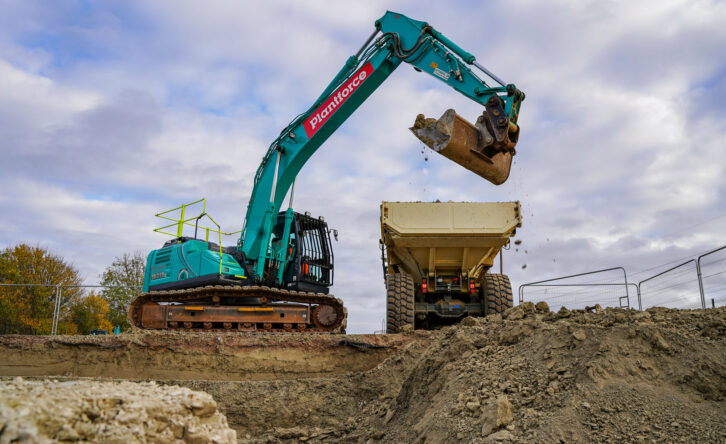
To prove the above points, we ran a whole lifecycle carbon study of one vehicle in our fleet, the Kobelco SK210 excavator. This included examining carbon production at every stage of the vehicle’s life, from the extraction of minerals for production, through to its import onto site, its operational life and its end-of-life auction.
These findings were applied to every machine on our fleet to complete the PAS audit. Studies for other models in our fleet are also underway to make our carbon reporting and standards even more accurate. From this, we were able to run due diligence on our carbon tracking, reporting and monitoring systems.
Beyond our own processes, we collaborated and engaged with our whole supply chain (both customers and suppliers) to help them meet PAS requirements on their route to net-zero. We also demonstrated a commitment to wider industry decarbonisation with our involvement in the Element1 and HyConstruct projects, including the hydrogen conversion of an articulated dump truck.
Why does our accreditation matter?
Gaining the PAS 2080 standard means all our customers can have confidence that we’re an environmentally responsible and compliant supplier. A well-established standard for Tier 1 construction businesses, it’s a marker that customers can trust and feel confident in when completing their environmental due diligence.
James says, “The PAS accreditation shows we’re no longer just a supplier of low emission machines. We’re a carbon-aware partner that actively helps customers and partners reduce the carbon footprint of projects and reach sustainable outcomes. By taking our responsibilities seriously and mentoring our supply chain, we hope to start a trickle down effect that will help everyone reach net zero.”